

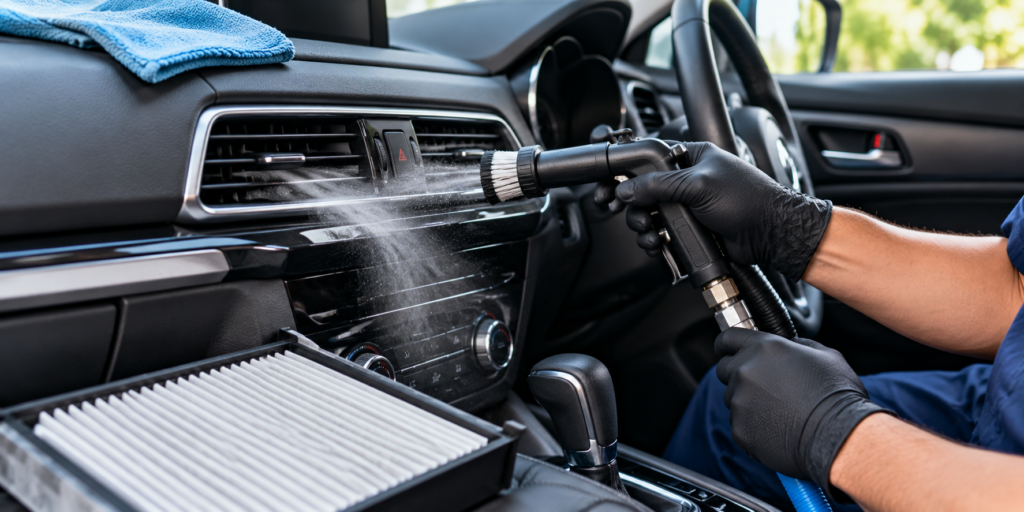
Your car’s air conditioning system does more than keep the cabin comfortable on hot days. It also moves air through the HVAC system, helps filter airborne contaminants, and plays an important role in keeping the cabin comfortable during everyday driving.
Over time, dust, pollen, leaves, dirt, and other debris can accumulate around the cabin air filter, vents, exterior air intake, and other accessible parts of the system. When enough contamination builds up, airflow can become restricted and unpleasant smells may become more noticeable.
Some basic cleaning can be handled at home, but not every air-conditioning problem is caused by dirt. If your AC still blows warm, smells unusual, makes noises, or performs poorly after basic maintenance, professional car air conditioning diagnosis and servicing can help identify the actual cause.
A clean ventilation system makes it easier for air to move through the parts designed to filter and distribute it.
That does not mean cleaning will automatically make the refrigerant system colder or fix a mechanical fault. However, when dirt, debris, or a heavily restricted cabin filter is contributing to weak airflow, simple maintenance may make a noticeable difference.
| Area | What Can Build Up | Possible Effect |
|---|---|---|
| Cabin air filter | Dust, pollen, leaves, fine debris | Restricted airflow and reduced ventilation performance |
| Exterior air intake | Leaves, dirt, organic material | Reduced airflow or moisture retention around the intake area |
| Dashboard vents | Surface dust and debris | Dust entering the cabin and visibly dirty vents |
| Evaporator area | Moisture and contamination | Persistent musty smells in some cases |
| Condenser | Insects, dirt, leaves, road debris | Potentially reduced heat transfer if contamination is severe |
Weak airflow does not automatically mean the air-conditioning system has failed. Sometimes the issue is something relatively simple, such as a dirty cabin filter or blocked air intake.
Common signs that your HVAC system may need cleaning or further inspection include:
The important distinction is between airflow and cooling.
If very little air is coming from the vents, a restricted filter, blower issue, blocked air path, or HVAC door problem could be involved. If the fan blows strongly but the air stays warm, cleaning is less likely to be the complete solution.
SuperCool Southport’s Gold Coast car air conditioning service covers diagnosis, servicing, leak detection, regassing, electrical issues, climate-control problems, and AC repairs, so you do not need to know exactly what has failed before booking.
The cabin air filter is one of the first places worth checking when airflow has become noticeably weaker.
Its role is to trap dust, pollen, and other airborne contaminants before they enter the passenger compartment. As the filter becomes loaded with material, the amount of air passing through it may decrease.
Depending on the vehicle, the cabin filter may be located:
Do not assume every vehicle uses the same access procedure. Check the owner’s manual or manufacturer information before removing panels.
Once removed, inspect the filter carefully.
| Filter Condition | Recommended Action |
|---|---|
| Light surface dust only | Check the manufacturer’s replacement interval and condition before deciding whether replacement is required. |
| Heavily covered in dust or debris | Replacement is generally preferable to trying to restore a heavily contaminated disposable filter. |
| Wet or damp | Replace it and investigate why moisture is reaching the filter area. |
| Damaged or torn | Replace it with the correct filter specification. |
| Strong odour | Replace the filter and inspect the HVAC system for other possible sources of the smell. |
When installing the replacement, check for an airflow-direction arrow on the filter and fit it according to the vehicle manufacturer’s instructions. Installing some filters backwards can affect how they function.
Your vehicle needs an external air source when the ventilation system is operating in fresh-air mode. The intake is commonly located around the lower edge of the windscreen, although its exact position varies by vehicle.
Leaves, twigs, dust, dirt, and organic debris can gather in this area, particularly if the car is frequently parked beneath trees.
With the engine and ventilation system switched off, remove loose material carefully using your hands, a soft brush, or a suitable vacuum attachment.
Do not force debris deeper into the intake opening, and avoid pouring large amounts of water, disinfectant, or cleaning products directly into the intake unless the vehicle manufacturer specifically recommends that procedure.
Keeping the area reasonably clear can help reduce debris entering the ventilation system and can also prevent wet organic material from sitting around the intake.
Dashboard vents are easy to overlook until a visible layer of dust begins forming on the louvers.
You can usually clean accessible vent surfaces with:
A brush can loosen dust trapped between vent louvers while a vacuum helps capture the material rather than pushing it farther into the air duct.
Avoid spraying large quantities of cleaner directly into the vent opening. Modern dashboards may contain electrical components, control modules, sensors, screens, actuators, and wiring nearby.
If you need moisture to remove grime, apply a small amount to the cloth rather than saturating the vent itself.
Not every unpleasant smell that becomes noticeable when the fan is running is actually coming from the AC system.
Air circulation can make existing cabin odours more obvious.
Potential sources include:
Vacuum the interior thoroughly and clean any obvious spills. If carpets or mats are wet, identify where the moisture came from and allow everything to dry properly.
If the smell occurs specifically when the AC first switches on, particularly if it is musty or damp, contamination around the evaporator or HVAC housing may be involved.
The evaporator is part of the air-conditioning system located inside the HVAC housing.
During normal AC operation, its surface becomes cold and moisture condenses on it. That moisture is normally collected and drained underneath the vehicle.
Because the evaporator regularly operates in a damp environment, contamination can sometimes accumulate around the evaporator or surrounding housing and contribute to persistent musty smells.
Vehicle-specific evaporator cleaners are available, but this is one area where following the correct procedure matters.
Different vehicles have different:
Introducing chemicals through the wrong opening can potentially damage electronics, sensors, trim, or HVAC components.
If the odour keeps returning after replacing the cabin filter and cleaning accessible areas, professional inspection may be safer than repeatedly spraying products into vents.
The condenser is typically mounted toward the front of the vehicle, where airflow can pass through it while the vehicle is moving.
It plays an important role in releasing heat from the refrigerant. Because of its location, it can also collect:
If the condenser is easily visible, you can inspect it for obvious contamination.
Be careful around the fins. They are thin and can be bent or damaged relatively easily.
Avoid aggressive pressure washing, hard brushes, screwdrivers, or other tools that can flatten the fins or damage the condenser.
If access is difficult or contamination is severe, leave cleaning to a technician.
Once you have replaced a dirty cabin filter and cleaned accessible intake and vent areas, test the system again.
Start the vehicle and try:
Pay attention to airflow strength, vent distribution, noises, smells, and cooling performance.
| What Happens After Cleaning | What It May Suggest |
|---|---|
| Airflow noticeably improves | A restricted filter or blocked airflow area may have been contributing to the problem. |
| Airflow remains very weak | The blower, controls, HVAC door, evaporator, or another internal component may need checking. |
| Airflow is strong but air stays warm | The issue is more likely related to cooling performance rather than simple ventilation cleaning. |
| Musty smell remains | Further inspection of the evaporator, drains, HVAC housing, or cabin may be required. |
| Noise changes with fan speed | The blower motor or debris near the blower may warrant further inspection. |
This is one of the most important things to understand before spending time repeatedly cleaning the system.
If the AC is not producing cold air, the fault may have little or nothing to do with dirt.
Potential causes of poor AC performance can include:
SuperCool Southport advises diagnosing the reason for poor cooling rather than automatically assuming every warm AC system simply needs more refrigerant. Their car AC repair and servicing includes leak detection, diagnosis, electrical issues, climate control, repairs, and regassing where appropriate.
These two symptoms are often confused, but they can point in different directions.
| Symptom | Possible Area to Check |
|---|---|
| Very little air comes from the vents | Cabin filter, blower motor, blower control, blocked airflow path, HVAC doors |
| Air comes out strongly but isn’t cold | Refrigerant system, compressor, leak, condenser, electrical or control issue |
| Airflow changes unpredictably | Blower controls, electrical faults, actuators or icing |
| Only some vents work properly | Vent doors, actuators, ducting or climate-control system |
This distinction can help you decide whether basic cleaning is a sensible first step or whether the system needs professional testing.
There is no universal cleaning schedule that suits every vehicle.
Start with the service and cabin-filter replacement intervals specified by the vehicle manufacturer. Then consider how and where the vehicle is driven.
You may want to inspect the filter and intake areas more frequently if the vehicle is regularly exposed to:
A quick visual check from time to time can help identify a clogged filter or blocked intake before airflow becomes noticeably poor.
It can still be useful to operate your AC periodically even when the weather is cooler.
Modern vehicle air conditioning is also commonly used during windscreen demisting because dry conditioned air can help remove moisture from the glass.
Regular operation also gives you an opportunity to notice changes in cooling performance, unusual noises, or smells before the hottest part of the year arrives.
For Gold Coast drivers, having the system checked before periods of consistently hot weather can be more convenient than discovering an AC fault when cabin cooling is needed most.
It can, but the improvement depends on what was restricting the system in the first place.
If the cabin air filter is heavily blocked, replacing it may reduce airflow restriction and restore ventilation performance.
If the outside intake is covered in leaves or debris, clearing it may improve the flow of fresh air into the HVAC system.
If a condenser is heavily obstructed, appropriate cleaning may help restore airflow across its surface.
However, cleaning will not correct problems such as:
That is why it is better to treat cleaning as routine maintenance rather than a universal AC repair.
Basic vent cleaning and cabin-filter replacement are manageable on many vehicles. Internal AC diagnosis and refrigerant work are different.
Consider booking professional diagnosis if you notice:
Automotive refrigerant systems operate under pressure and require appropriate equipment, refrigerant identification, recovery procedures, and fault diagnosis.
If you are on the Gold Coast, SuperCool provides car AC diagnosis, repairs and regassing across the Gold Coast from its Southport workshop. Their service covers passenger cars, 4WDs, utes, light commercial vehicles and other automotive applications.
Not automatically.
If an AC system is low on refrigerant, it is worth understanding why the refrigerant level has changed before treating repeated regassing as the entire solution.
A leak from a seal, hose, fitting, or component may cause refrigerant to escape. If that underlying problem is not identified, cooling performance may deteriorate again.
This is particularly worth investigating if:
SuperCool Southport specifically focuses on diagnosing the fault before assuming every poor-performing system only needs a regas.
Yes, depending on the workshop.
If your vehicle is already due for routine maintenance, it can be convenient to mention any air-conditioning problems at the same time.
SuperCool Southport provides both car servicing and mechanical repairs as well as specialist automotive air conditioning work. If your car needs servicing and the AC has also become weak, warm, noisy, or smelly, mention both when booking so the workshop can advise what can be checked during the visit.
| Task | DIY Friendly? | Important Note |
|---|---|---|
| Inspect cabin air filter | Usually | Follow the vehicle-specific access procedure. |
| Replace cabin air filter | Usually | Use the correct filter and airflow direction. |
| Clean visible dashboard vents | Yes | Avoid spraying excessive liquid into vents. |
| Remove leaves from external intake | Usually | Do not push debris deeper into openings. |
| Inspect condenser visually | Yes, if accessible | Condenser fins are delicate. |
| Evaporator deep cleaning | Vehicle dependent | Incorrect chemical application can cause problems. |
| Refrigerant handling | No | Requires appropriate equipment and professional procedures. |
| Leak or electrical diagnosis | Professional recommended | Accurate diagnosis prevents unnecessary parts or repeated regassing. |
Yes. A heavily restricted cabin air filter can reduce the volume of air moving through the HVAC system. Replacing a clogged filter may restore airflow if the filter is the main restriction.
A dirty cabin filter, moisture inside the HVAC housing, contamination around the evaporator, wet carpet, or other cabin moisture can all contribute to musty smells. If the smell remains after basic cleaning and filter replacement, the HVAC system may need professional inspection.
It is better to avoid saturating dashboard vents with liquid. Electrical components and HVAC parts may be located nearby. For routine cleaning, use a microfiber cloth or soft detailing brush and follow any vehicle-specific instructions for deeper cleaning.
Cleaning surface dust from vents may improve cleanliness, but it will not fix refrigerant loss, compressor faults, electrical problems, or other causes of poor cooling. If airflow is strong but the air remains warm, have the AC system diagnosed.
No. Poor cooling can have several causes. A professional check can determine whether the issue involves refrigerant, a leak, electrical problems, the compressor, climate-control components, or another fault.
SuperCool Southport provides automotive air-conditioning diagnosis, servicing, leak detection, regassing, electrical fault diagnosis, and repairs from its workshop at 51 High Street, Southport. You can also view its Gold Coast service area if you are travelling from another suburb.
Keeping your car’s AC system clean starts with relatively simple maintenance. Check the cabin air filter, keep the exterior air intake free from debris, clean dusty vents carefully, and pay attention to changes in airflow, smells, and cooling performance.
The important part is knowing where routine cleaning ends and actual AC diagnosis begins.
If a dirty cabin filter was restricting airflow, replacing it may make an immediate difference. But if the system still blows warm, remains weak, makes unusual noises, develops recurring smells, or loses cooling again after previous work, there may be an underlying AC fault that cleaning cannot solve.
For professional help, SuperCool Southport offers car air conditioning servicing and repairs, including diagnosis, leak detection, electrical fault checks, climate-control work, and regassing when required.
Supercool Car Air Conditioning © 2026 | Designed and developed by 123 Digital |Privacy Policy | Blog

No: AU01712